|
Yellowstone National Park |
|
Yellowstone is the only place in the lower 48 states where a population of wild bison has persisted since prehistoric times, although fewer than 50 native bison remained here in 1902. Fearing extinction, the park imported 21 bison from two privately-owned herds, as foundation stock for a bison ranching project that spanned 50 years at the Buffalo Ranch in Yellowstone's Lamar Valley. Activities there included irrigation, hay-feeding, roundups, culling, and predator control, to artificially ensure herd survival. By the 1920s, some intermingling of the introduced and wild bison had begun. With protection from poaching, the native and transplanted populations increased. In 1936, bison were transplanted to historic habitats in the Firehole River and Hayden Valley. In 1954, the entire population numbered 1,477. Bison were trapped and herds periodically reduced until 1967, when only 397 bison were counted parkwide. All bison herd reduction activities were phased out after 1966, again allowing natural ecological processes to determine bison numbers and distribution. Although winterkill takes a toll, by 1996 bison numbers had increased to about 3,500.
Bison are enjoyed by visitors, celebrated by conservationists, and revered by Native Americans. Why are they a management challenge? One reason is that about half of Yellowstone's bison have been exposed to brucellosis, a bacterial disease that came to this continent with European cattle and may cause cattle to miscarry. The disease has little effect on park bison and has never been transmitted from wild bison to a visitor or to domestic livestock. Despite the very low risk to humans and livestock today, since the possibility of contagion exists, the State of Montana believes its "brucellosis-free" status may be jeopardized if bison are in proximity to cattle. Although the risk is very low, if cattle become infected, ranchers can be prevented from shipping livestock out of state until stringent testing and quarantine requirements are met. Although scientists are studying new possibilities, there is yet no known safe, effective brucellosis vaccine for bison. Ironically, elk in the ecosystem also carry the disease, but this popular game species is not considered a threat to livestock.
The NPS, U.S.D.A. Forest Service, U.S.D.A. Animal and Plant Health Inspection Service, and the State of Montana completed a Draft Environmental Impact Statement for the Interagency Bison Management Plan for the State of Montana and Yellowstone National Park for public release on June 12, 1998. The purpose is to maintain a wild free-ranging bison population and to address the risk of brucellosis transmissions to protect the economic interest and viability of the livestock industry in Montana. Alternatives being considered range from: allowing bison to freely range over a large portion of public land inside and outside the park; managing bison like elk and other wildlife through controlled hunting outside park boundaries; and attempting to eradicate brucellosis by capturing, testing, and slaughtering infected bison at numerous facilities constructed inside the park. Additional options include purchase of additional winter range; attacking brucellosis with a (yet unknown) safe and effective vaccine for bison; and quarantine of animals at appropriate locations such as Indian Reservations or other suitable sites outside Yellowstone. * Information on this page provided by the NPS.
|
|
 Bison
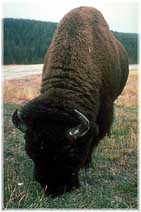
are the largest mammals in Yellowstone National Park. They are strictly
vegetarian, a grazer of grasslands and sedges in the meadows, the foothills, and
even the high-elevation, forested plateaus of Yellowstone. Bison males, called
bulls, can weigh upwards of 1,800 pounds. Females (cows) average about 1,000
pounds. Both stand approximately six feet tall at the shoulder, and can move
with surprising speed to defend their young or when approached too closely by
people. Bison breed from mid-July to mid-August, and bear one calf in April and
May. Some wolf predation of bison is documented in Canada and has recently been
observed in Yellowstone.
Bison
are the largest mammals in Yellowstone National Park. They are strictly
vegetarian, a grazer of grasslands and sedges in the meadows, the foothills, and
even the high-elevation, forested plateaus of Yellowstone. Bison males, called
bulls, can weigh upwards of 1,800 pounds. Females (cows) average about 1,000
pounds. Both stand approximately six feet tall at the shoulder, and can move
with surprising speed to defend their young or when approached too closely by
people. Bison breed from mid-July to mid-August, and bear one calf in April and
May. Some wolf predation of bison is documented in Canada and has recently been
observed in Yellowstone.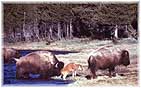 Bison
are nomadic grazers, wandering high on Yellowstone’s grassy plateaus in
summer. Despite their slow gait, bison are surprisingly fast for animals that
weigh more than half a ton. In winter, they use their large heads like a plow to
push aside snow and find winter food. In the park interior where snows are deep,
they winter in thermally influenced areas and around the geyser basins. Bison
also move to winter range in the northern part of Yellowstone.
Bison
are nomadic grazers, wandering high on Yellowstone’s grassy plateaus in
summer. Despite their slow gait, bison are surprisingly fast for animals that
weigh more than half a ton. In winter, they use their large heads like a plow to
push aside snow and find winter food. In the park interior where snows are deep,
they winter in thermally influenced areas and around the geyser basins. Bison
also move to winter range in the northern part of Yellowstone.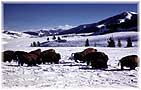 Yellowstone
wildlife freely move across boundaries set a century ago without knowledge of
each animal’s habitat needs. But bison are not always unwelcome outside the
park. In the park managers have tried to limit bison use of lands outside the
park through public hunting, hazing bison back inside park boundaries, capture,
testing for exposure to brucellosis, and shipping them to slaughter. Since 1990,
state and federal agency personnel have shot bison that leave the park. During
the severe winter of 1996-1997, nearly 1,100 bison were sent to slaughter. The
carcasses sold at public auction, or shot and given to Native Americans. These
actions reduced the bison population to about 2,200 in 1997-1998. In the mild
winter of 1997-1998, only 11 bison were killed in management actions, all in
January, and all from the West Yellowstone area. Six bison were shot and five
were sent to slaughter. Through the winter another 21 bison are known to have
died, 12 of natural causes, and 9 from other causes such as collisions with
vehicles.
Yellowstone
wildlife freely move across boundaries set a century ago without knowledge of
each animal’s habitat needs. But bison are not always unwelcome outside the
park. In the park managers have tried to limit bison use of lands outside the
park through public hunting, hazing bison back inside park boundaries, capture,
testing for exposure to brucellosis, and shipping them to slaughter. Since 1990,
state and federal agency personnel have shot bison that leave the park. During
the severe winter of 1996-1997, nearly 1,100 bison were sent to slaughter. The
carcasses sold at public auction, or shot and given to Native Americans. These
actions reduced the bison population to about 2,200 in 1997-1998. In the mild
winter of 1997-1998, only 11 bison were killed in management actions, all in
January, and all from the West Yellowstone area. Six bison were shot and five
were sent to slaughter. Through the winter another 21 bison are known to have
died, 12 of natural causes, and 9 from other causes such as collisions with
vehicles.